Product designer · Design strategist · Enterprise systems

Enterprise software rarely fails because of the interface. It fails when people stop trusting the system.

I'm a research-led product designer. I find the real problem hiding under the request — then design the product that fixes it, not just the interface.

14+
Years designing enterprise systems
$20M+
Product revenue influenced
100+
Research interviews & workshops
7+
Products shipped across the globe
Hero artworkDrop the rendered illustration at/hero-research-stack.png
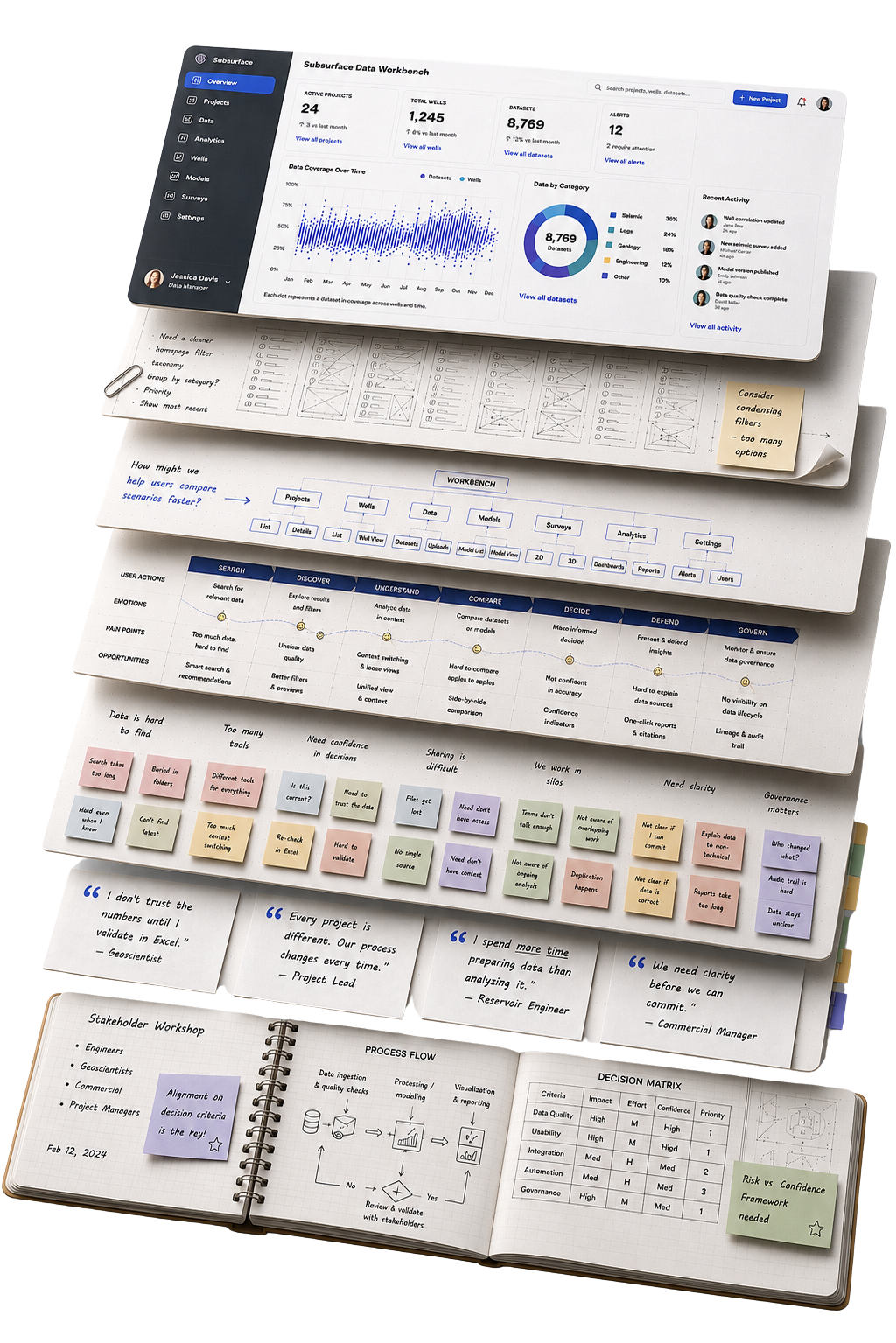
Enterprise UX research artifacts cascading beneath a Subsurface Data Workbench dashboard — printed wireframes, information architecture, journey maps, an affinity-mapping wall, research quotes and a workshop notebook.
Before the interface comes the harder question — what problem are we actually solving?
Selected work

Four transformations.

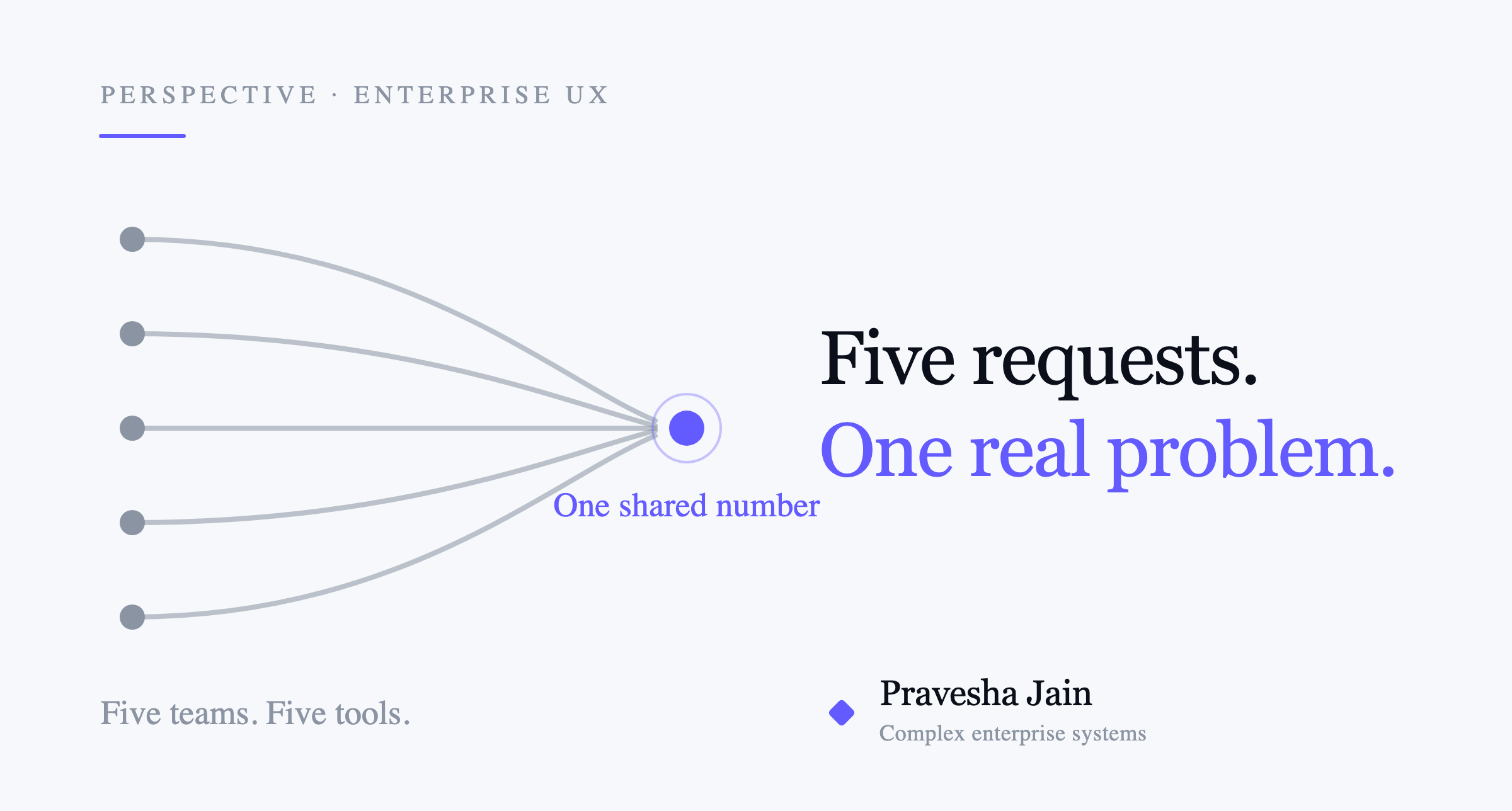
Every engagement began with one request. Research uncovered another problem entirely.

Enterprise data platform · Flagship

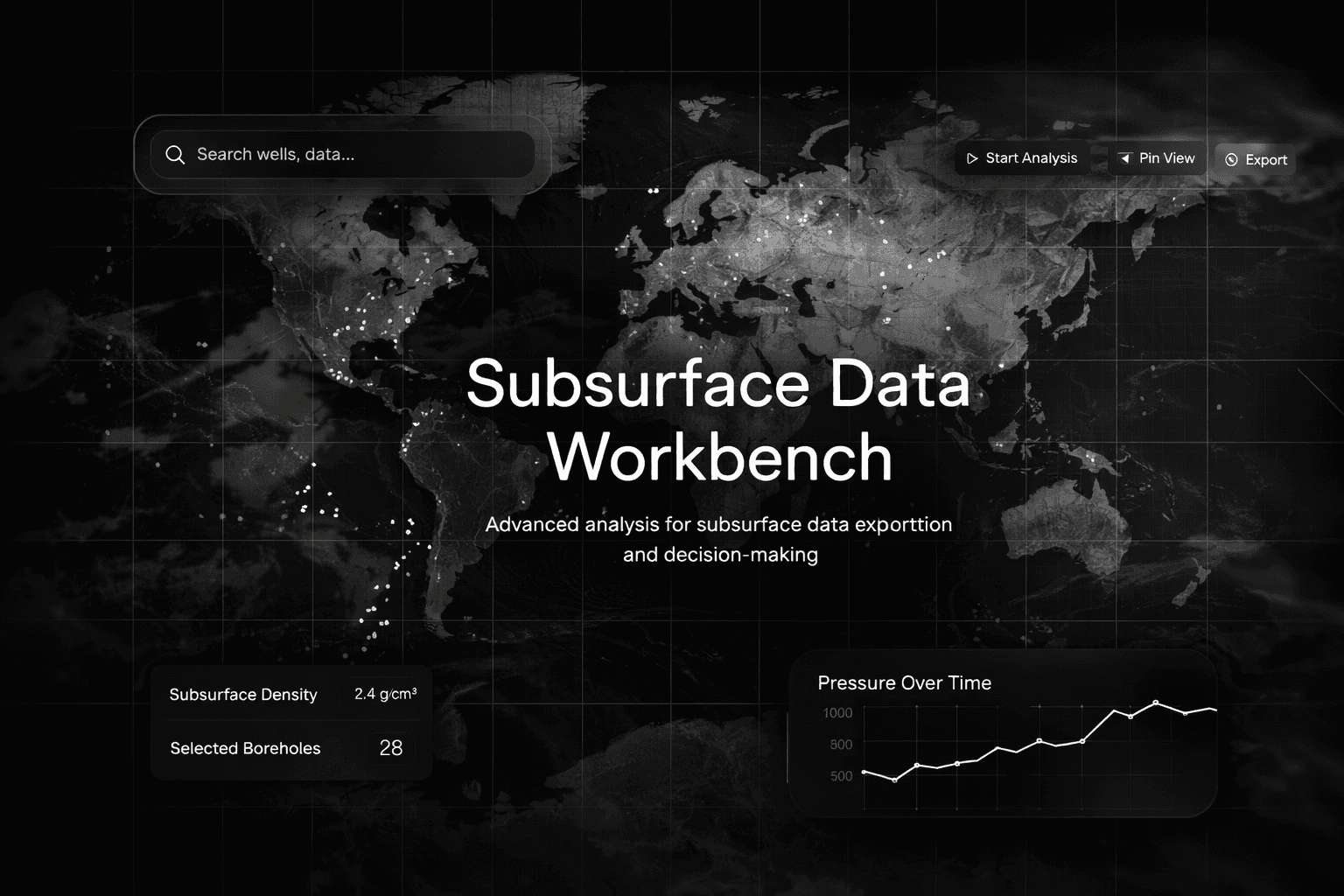
Subsurface Data Workbench

Stakeholders asked forBetter search & discovery
Confidence before decisions
Read the case study →
Planning platform · Research-led

Facility Planner

Stakeholders asked forEstimation software
Decision support
Read the case study →
Operations platform · Research-led

Vendor & Contractor Management

Stakeholders asked forDashboards
A shared operating model
Read the case study →
Design leadership · Mentoring

Building UX capability

The organisation asked forBetter designers
A stronger design organisation
Read the case study →
My operating model

The same pattern. Every time.

Every enterprise product looked different. The thinking behind them never changed.

Listen

What every team believes the problem is.

Find the hidden disagreement

Where teams secretly define the problem differently.

Reframe the problem

Turn the request into the real challenge.

Design the operating model

Decisions, ownership and workflows — not just screens.

Earn trust

Products people trust more than their workarounds.

“Every successful project I've led changed direction at the hidden disagreement.”

Design starts long before Figma

It's not a design process. It's a thinking process.

Typical UX process
1Research
2Define
3Ideate
4Design
5Test
6Deliver
Focuses on screens and features.
How I work
1Listen
2Find the hidden disagreement
3Reframe the problem
4Design the operating model
5Design the interface
6Earn trust
Focuses on the right problem and the right system.
About · Reflection

What fourteen years changed.

Early on, I believed better interfaces made better products. Years alongside geoscientists, engineers and operations teams taught me otherwise: people don't struggle with software — they struggle with uncertainty, and confidence, not features, decides whether a product succeeds.

Research leader Product strategist Systems thinker Team builder People mentor
Certified
LUMA · Design Thinking Facilitator NN/g · Measuring UX & ROI NN/g · Research Ops HFI · Certified Usability Analyst HFI · UX Analyst IIT Delhi · Design Thinking & Innovation
Ecosystems & platforms I've worked across
Experience

How my thinking evolved

Not a list of roles — the shifts that changed how I approach every enterprise problem.

2023 — Present
Leadership
SLB (Schlumberger) · Houston & Pune

UX Lead — Data Platforms

Lumi Data Workspace · Unified Data Services · Operational Data Foundation
Learned that the hardest problems are organisational, not visual.

Design leadership became about how teams decide, who owns the data, and whether they trust it — not just what ships.

2016 — 2022
Depth
SLB (Schlumberger) · Pune

UX Lead / Senior UX Researcher

IT Data Platform · CIM Catalog · Cognitive Procurement (Athena) · BI ecosystems
Learned that research earns the right to redefine the problem.

Turned tangled data and governance constraints into systems people adopted — because adoption follows trust, not features.

2012 — 2016
Foundation
KPIT · Mindtree · Altran

UX & Interaction Designer

EA Sports · Genpact · Unilever · Vodafone · telecom & data platforms
Learned the fundamentals: behaviour, business process, and influence.

EA Sports → interaction shapes behaviour; Unilever → systems fail when process is ignored; Genpact → research moves business decisions, not just validates UI.

Influence

How I scale design

Building the systems, standards and communities that outlive any single project.

ResearchOps

  • Research playbooks
  • Templates & repositories
  • Study-design standards
  • Insights library

Leadership

  • Hiring & interviewing
  • Career growth & mentorship
  • Design reviews & strategy
  • Team development

Community

  • UX SIG leader at SLB
  • Webinars & knowledge sharing
  • Workshops & panels
  • Cross-team collaboration

Accessibility

  • Accessibility champion
  • Accessible design guidelines
  • Audits & inclusive practices
  • Awareness programs

Recognition

SLB Bronze Award — Performance LiveAward
SLB Bronze Award — Rise of the PhoenixAward
Speaker — Reservoir Symposium AsiaDesign Thinking for complex engineering problem-solving.Speaking
Global innovation presentation — SLB, BeijingPresented an innovation initiative to international stakeholders.Keynote
Speaker — International Society of Women EngineersOn design, research & women in enterprise tech.Speaking
Gold Medalist — BCA, Bharati VidyapeethHonor
A closing thought

Most organisations don't have a design problem. They have a clarity problem.

Interfaces only reflect the quality of the decisions made before design begins. If your team is trying to untangle complexity before building the next thing, I'd love to have that conversation.

Senior / Lead / Principal Product Design Enterprise UX & product strategy Research-led product design Houston · Pune · remote or relocation
All work
Enterprise data platform · Case study

Subsurface Data Workbench

A cloud platform that helps geoscientists discover, validate, and share trusted subsurface data for high-stakes exploration decisions.

Redesigned an enterprise data platform after research revealed low adoption caused by poor trust, fragmented discovery, and governance friction.

Role
UX Lead
Year
2023 — Present
Domain
Subsurface
Team
Houston ↔ Pune
Data Workbench — product overview
At a glance
The problem

Domain users struggled to discover, evaluate, and confidently use subsurface data because quality, governance, and readiness were hidden throughout the workflow.

My role

Led end-to-end UX from research through interaction design — defining the product vision, information architecture, workflows, and future-state experience.

The outcome

Repositioned the Data Workbench from a passive data catalog into a trusted decision-support platform for governed data discovery.

The challenge

Existing workflows forced experts to search through fragmented datasets with little visibility into quality, readiness, or lineage. Engineers often relied on personal knowledge to determine which datasets could be trusted, leading to duplicated effort, inconsistent decisions, and low confidence in the platform.

Research findings

Research revealed two equally important user groups:

Data Manager
Owner of the data inventory

Owns the data inventory and makes sure users can actually find and access the right data — importing, organizing, packaging, and governing access across the catalog.

Responsibilities
  • Importing and organizing datasets.
  • Creating and sharing data packages.
  • Permissions and access control.
  • Catalog management and data availability.
Typical tasks
  • Upload new seismic surveys and register wells.
  • Create data packages and share datasets.
  • Assign permissions and manage access.
  • Archive datasets.
Subsurface Expert
Geoscientist / engineer · data consumer

Makes high-stakes interpretation and modeling decisions, and needs to move fast without staking months of work on the wrong data.

Goals
  • Find the right data from domain intent, not file names.
  • Know at a glance what is ready and fit-for-purpose.
  • Commit to data and decisions with confidence.
Frustrations
  • Discovery starts from filenames and storage paths.
  • Readiness and QC signals arrive too late.
  • Wrong data can invalidate months of work.
The hard part: these roles are tightly coupled. The experience had to let data managers organize and govern access without slowing experts down, and let experts find and use data fast without breaking governance.
Research insights

Through interviews, workshops, and journey mapping, five themes consistently emerged:

  • Experts searched by domain knowledge, not file structures.
  • Data quality was only discovered after investing significant effort.
  • Maps exposed unqualified datasets without context.
  • Sharing created uncontrolled copies that broke governance.
  • Trust depended on experienced colleagues rather than the platform itself.
The user journey

Journey mapping revealed four critical moments where user confidence was either built or lost. Rather than redesigning individual screens, the experience strategy focused on improving these decision moments.

01
Find trusted data
Goal
Start from domain concepts and geography, not storage structure.
Risk
Searching by filename leads to the wrong starting point.
02
Validate confidence
Goal
See readiness and QC signals before investing time.
Risk
Late signals mean effort spent on unusable data.
03
Use with assurance
Goal
Commit data to interpretation with a clear fitness verdict.
Risk
Unqualified data can invalidate months of work.
04
Share without losing governance
Goal
Collaborate on one qualified, referenced version.
Risk
File exports break lineage and compliance.
Design vision

Design the Data Workbench as a trusted upstream data supply platform — where readiness, lineage, and governance are embedded quietly into everyday expert workflows.

Before / after
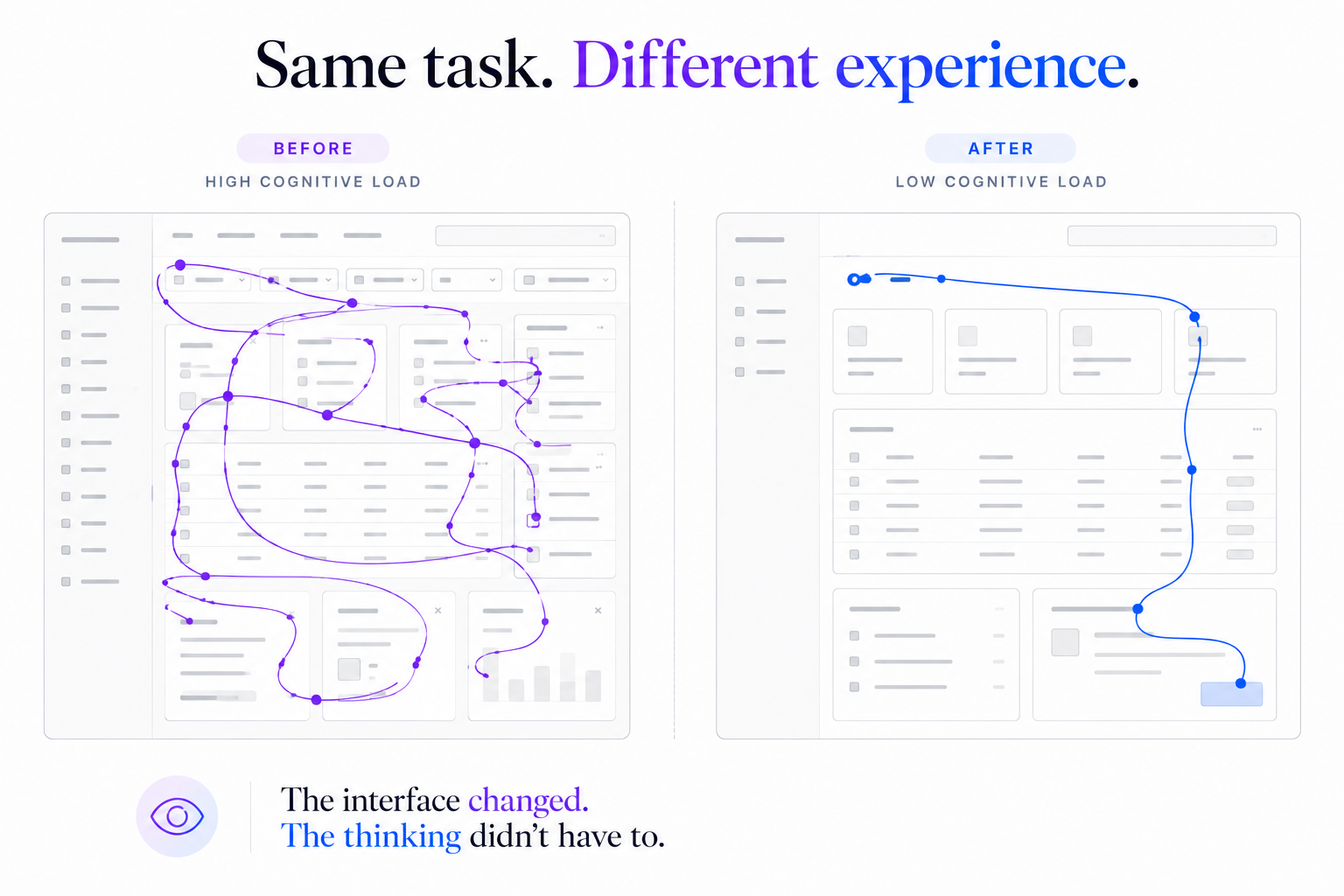
Before
  • File- and format-based discovery.
  • Late visibility into QC and readiness.
  • Unqualified data exposed in maps and search.
  • Manual file sharing creating shadow copies.
  • Reactive governance model.
AfterOptimized
  • Concept-driven discovery.
  • Early and consistent readiness signals.
  • Only qualified data visible during discovery.
  • Governed, reference-based sharing.
  • Built-in, quiet governance framework.
Experience strategy

Four design principles, each addressing one decision moment — shown with the screen that delivers it.

① Find trusted data

Start from domain intent

Problem
Discovery forced experts through file names and storage paths — far from how they think.
Decision
Let experts begin from domain concepts and geography.
Design
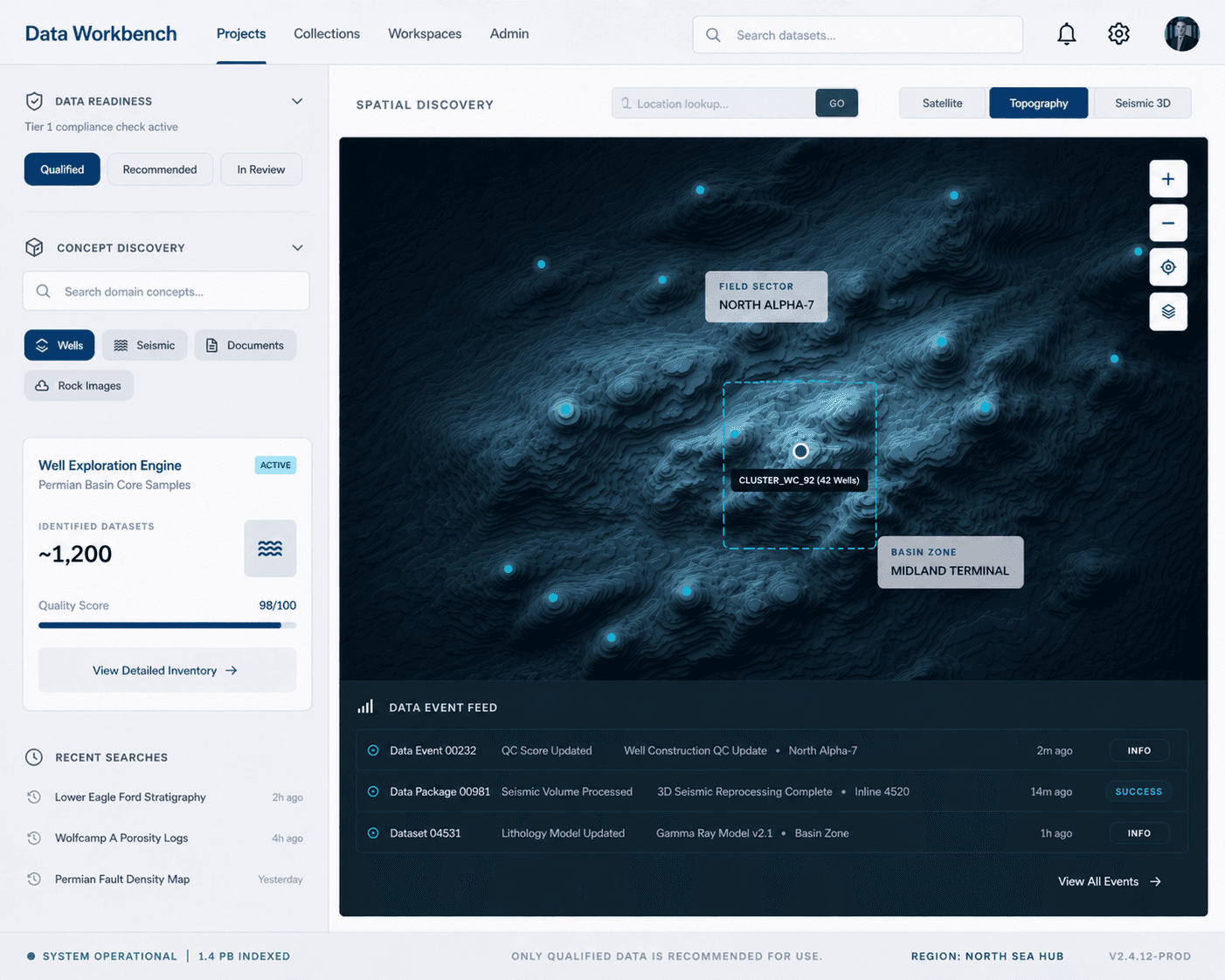
Dual discovery — concept-based and spatial — over a map of fields and wells.
Impact
The right starting point, with far less noise early in the workflow.
Data Workbench — spatial and concept discovery screen
② Validate confidence

Surface trust early

Problem
Readiness and QC signals arrived late, after time was already invested.
Decision
Move readiness and QC upstream into first-class filters.
Design
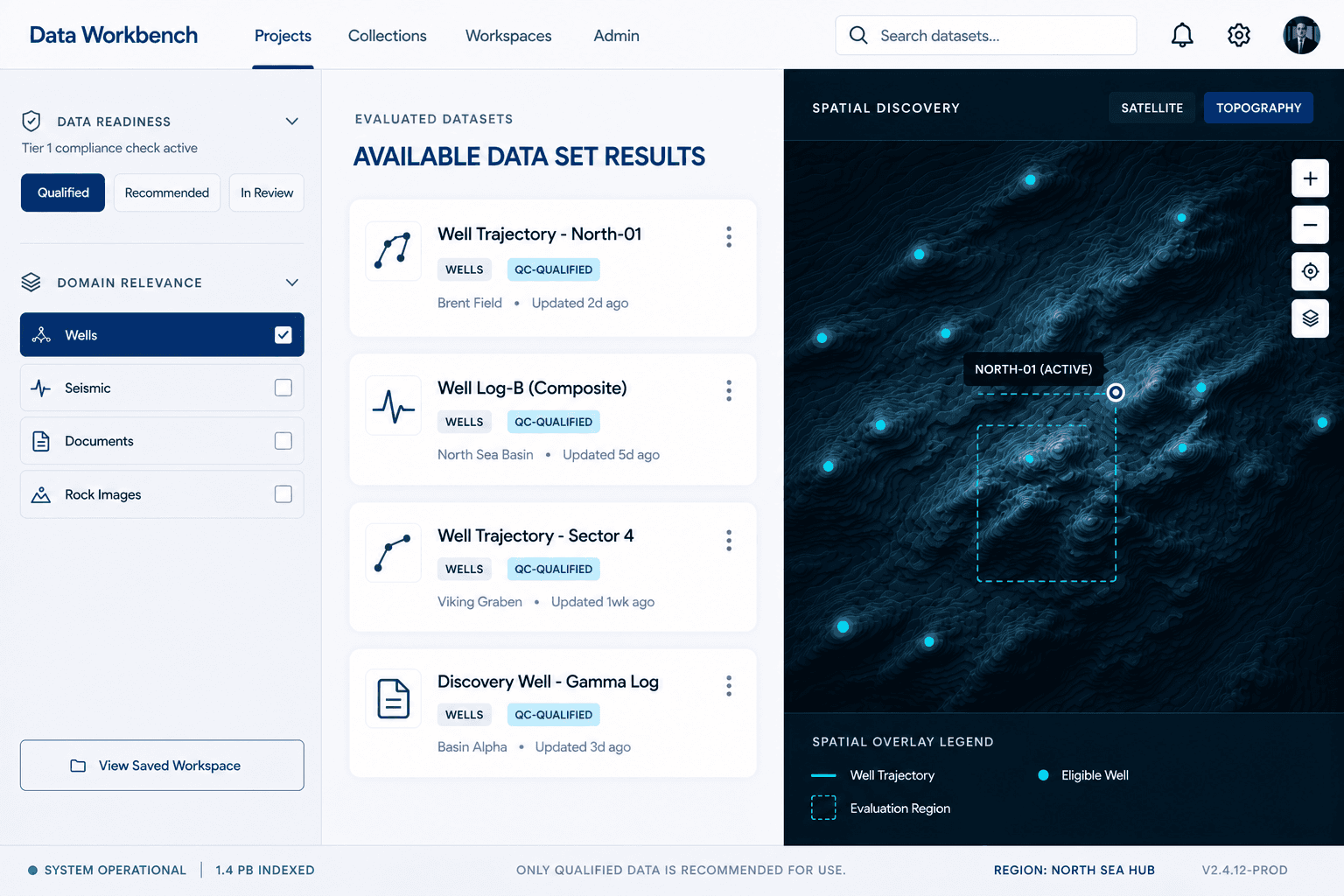
Only system-recommended, QC-qualified datasets enter the decision space.
Impact
Risk is prevented upstream instead of discovered mid-workflow.
Data Workbench — readiness-filtered data results screen
③ Use with assurance

Design for confident decisions

Problem
The last step before interpretation lacked a clear verdict on fitness.
Decision
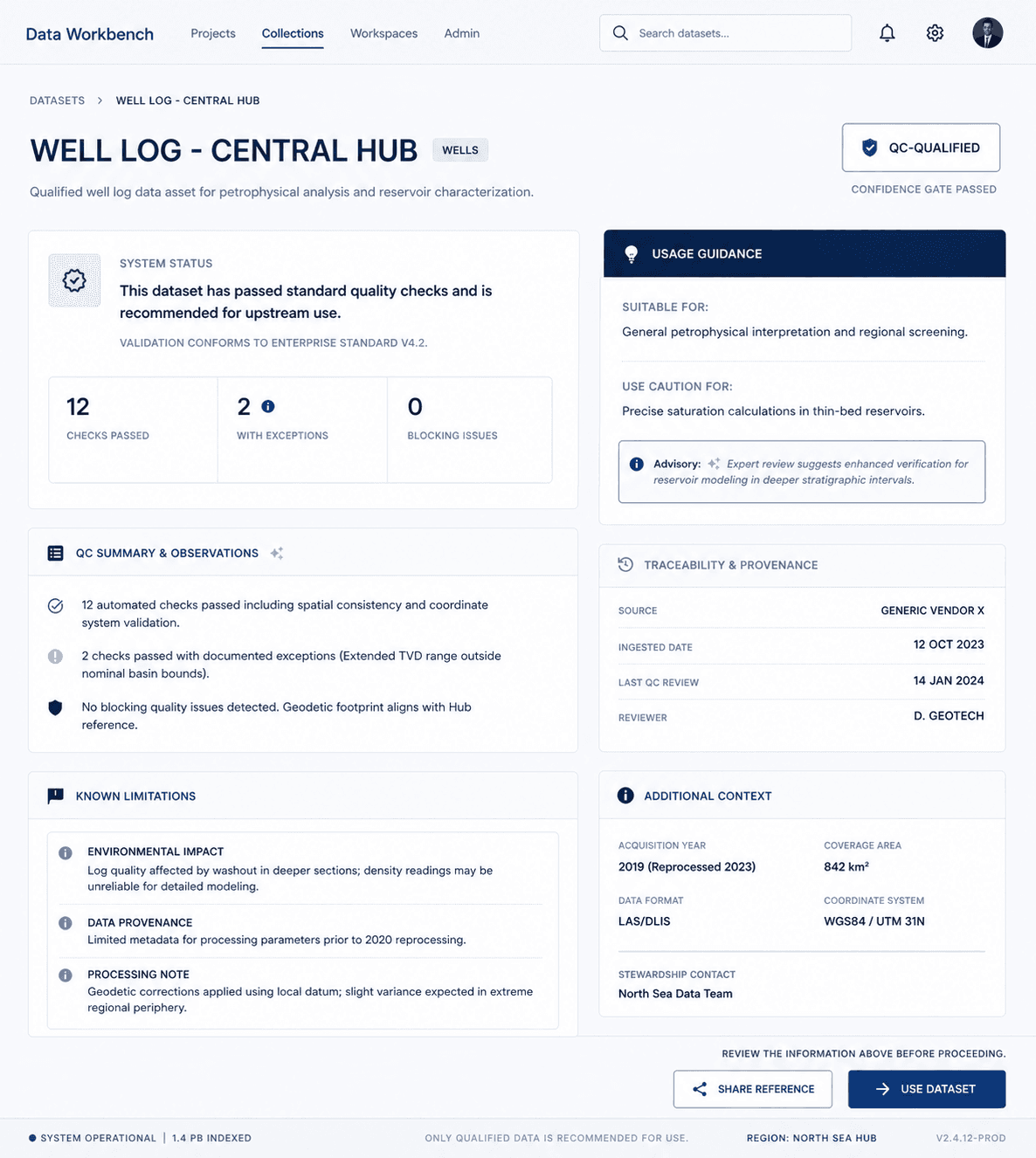
Turn QC from raw output into a confidence gate.
Design
Explain fitness, limitations, and intended use at the point of decision.
Impact
Trust shifts from tribal knowledge to system-supported decisions.
Data Workbench — dataset confidence-gate screen
④ Share without losing governance

Governance without friction

Problem
File exports created shadow copies that broke lineage and compliance.
Decision
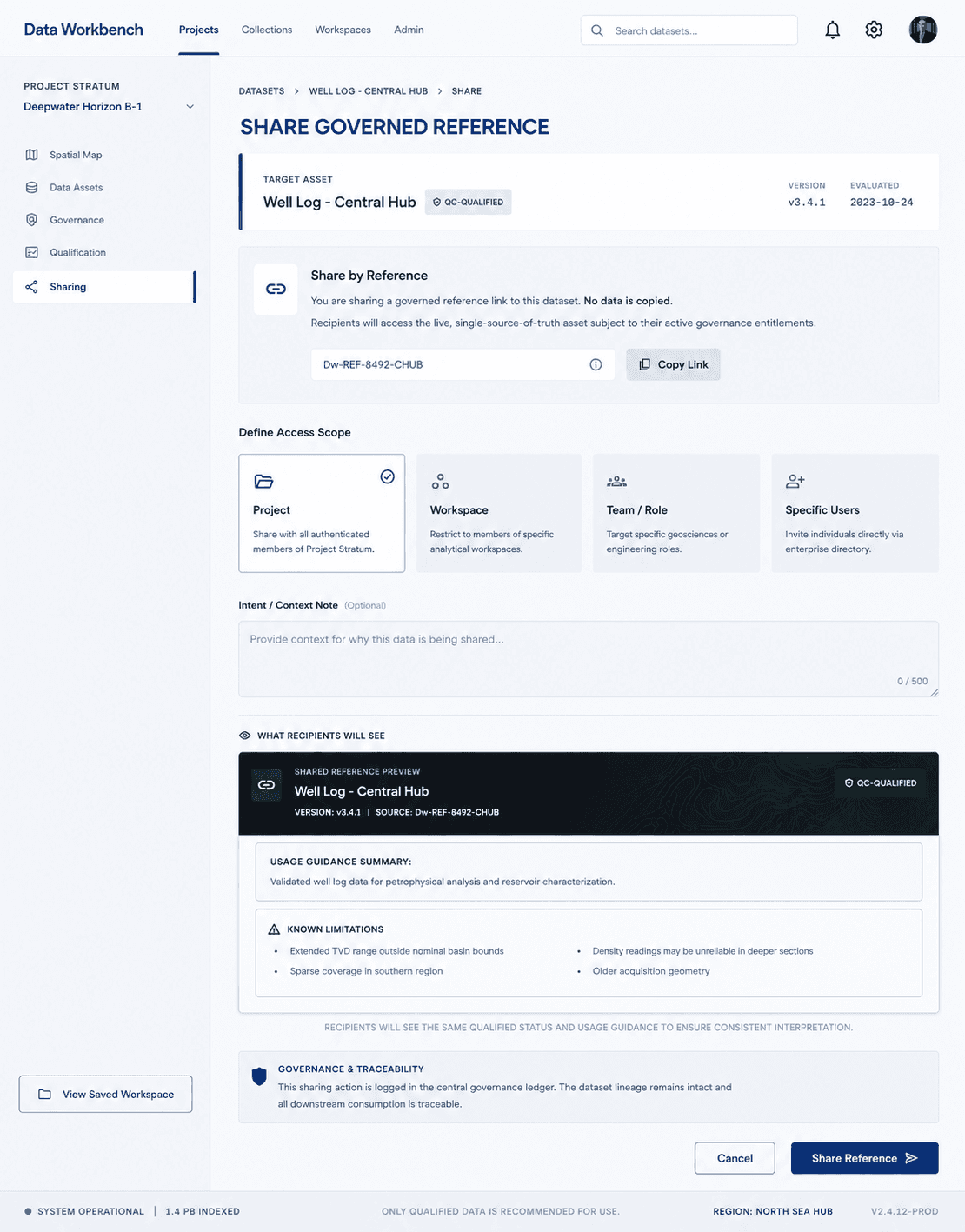
Replace exports with reference-based collaboration.
Design
“Use Dataset” and “Share Reference” on one qualified version, with scoped access.
Impact
Speed without shadow data or compliance risk.
Data Workbench — governed reference sharing screen
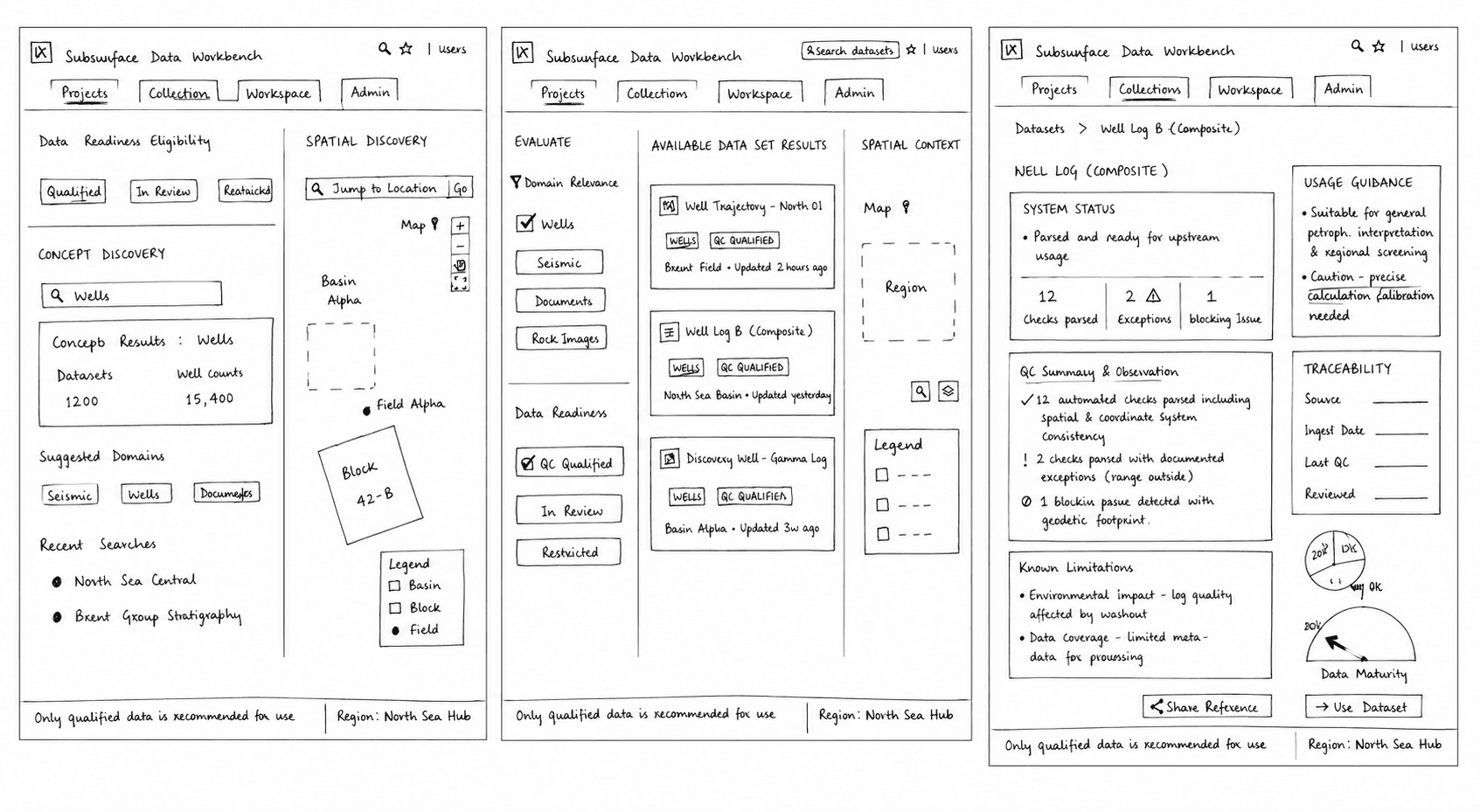
Early exploration · low-fidelity wireframes
Data Workbench — low-fidelity wireframes of the end-to-end flow

Before high-fidelity design, low-fidelity wireframes mapped the end-to-end flow across all four decision moments — testing structure and sequence before visual detail.

Scope
Supported users
Data Managers + Domain Experts
Core workflows
Discovery → Validation → Sharing
Experience focus
Trust, Governance & Data Readiness
Expected experience outcomes
  • Earlier visibility into data readiness.
  • Reduced reliance on tribal knowledge.
  • Better governed collaboration.
  • Higher confidence before interpretation begins.
Reflection

In subsurface workflows, speed without trust is risk, and governance without usability is friction. The Data Workbench delivers both.

What I'd do next. Deepen system feedback loops — instrumenting QC bottlenecks, expanding proactive guidance, and refining patterns as new data types are introduced.